We now have Life Clubs all around the country from Edinburgh to London. Find yours now.
Read more about what's happening this week at Life Clubs in our blog.
What the press says:
3 Unlikely Love Gurus... and others
3 Unlikely Love Gurus: Your best friend isn’t always the best person to go for advice
When you first met your man, you’d talk to anyone about your dates or what his last email said. But as your intimacy shutters go down you may begin to feel you’re betraying him if you seek advice from anyone outside your inner circle. “Big mistake,” says Life Clubs founder, Nina Grunfeld, author of The Big Book Of Me. “Your best love mentors are always the most unlikely suspects…”
Mentor-at-the-moment: Your Mum
Mentor-in-waiting:
Your Mum’s Best Friend
“Your mum is often too close to you to give good advice,” says Grunfeld. “She has protective instincts, which cloud her judgement. She also knows that if she’s too critical of your man, it could backfire. So seek out her best friend. Like your mum, she’s known you since you were in nappies, so she can penetrate any social mask you wear and won’t be afraid to give a pull-no-punches perspective”
What To Ask: “When do you think I’ve been at my happiest and why?”
Mentor-at-the-moment: Your Best Friend
Mentor-in-waiting: A Total Stranger
“Your best mate loves you but she’s baised, especially if she’s single and wants to reclaim you” says Grunfeld. “Some of the best relationship chats are with people you’ll never see again. You won’t care if they disapprove of your boyfriend, so you’re unlikely to edit his dark side. Chatting to someone on holiday or in a cafe is ideal”
What To Ask: “What’s the number one lesson you’ve ever learnt about relationships?”
Mentor-at-the-moment: Your favourite Colleague
Mentor-in-waiting: Your Hairdresser
“Don’t tell work colleagues too much about your personal life” says Grunfeld. “They may tiptoe around your feelings, rather than being straight. Turn to your hairdresser for an objective view instead. Rather than baring your soul, phrase it as if it’s a dilemma your friend is having for no-holes-barred advice with a blow dry on the side.”
What To Ask: ” My friend Sarah’s having a problem with her boyfriend…”
A Lesson For Life
Do you sometimes get the feeling that you could be getting more out of your life? Is everything ‘OK’, but not quite what it could be? If so, you might want to get yourself down to your local life club.
Set up in London in 2005 by former Daily Telagraph self-help columnist Nina Grunfeld, the weekly 90 minute workshops now take place all over the country. The purpose of the meetings is to help attendees work out exactly what they want from life and how to go about getting it.
Each session starts off with everyone telling the person next to them something positive that’s happened to them that day, before focusing on the weeks topic- anything from ‘Coping with Change’ to ‘Being your own Hero’. Based on the principle that its easier to open up to a stranger, most of the work is done in pairs, each one supervised by a different life coach. Every group uses the same ‘discovery techniques’ invented by Grunfeld, whose inspiration came from hitch-hiking as a student: “You pour out your heart and soul to someone, then you never see each other again.’
Potential life clubbers keen on guarding their privacy will be encouraged by the cardinal rule: ‘What happens at Life Clubs stays at Life Clubs’ A one-and-a-half hour session costs £15.
Back To Life
Changing your life needs careful planning not hasty new years resolutions. Life coach Nina Grunfeld recommends making changes one step at a time.
I don’t know about you, but I always feel excited about a new year. It feels like a fresh start, as if I could now achieve what I’ve always wanted to achieve. For years I regularly started Canadian Army exercises every January 1st, only to give up at around the 16th. These days – older and wiser – New Year’s resolutions have moved over and I set myself longer-term goals for the year ahead. Instead of going crazy for the first couple of weeks of January, I’ve found a few sports I like – tennis, walking, swimming and dancing – and am more realistic about my goals. I now know that if I don’t push myself too hard, I stand a better chance of keeping them going for longer.
What motivates you to keep to your goals? Right now, take a piece of paper and write down three things that you’d like to achieve this year. One could be a personal goal for you – wanting to lose weight, wanting to see friends more often, wanting to relax a bit more. One could be work related – maybe changing job, maybe to get promoted, maybe to get a good annual appraisal. The third could be to do with other people – possibly doing a run for a charity, visiting your parents more, spending special time with your children – those sort of things.
Once you’ve written down your three goals for the year, imagine those goals belong to someone else and they’re asking you how to stick to them. For example, if one of your goals is to get rid of all the rubbish in your home so that it looks like the sexy minimalist interiors in magazines, imagine that’s the goal of one of your best friends and that they’re phoning you up in despair: “What can I do? I want to get rid of stuff but I’m worried that everything I chuck out I’m going to need sooner or later, and all these things I find remind me of the things I haven’t done – recipes I’ve never cooked and places I’ve never been to. Help – give me some advice.” In your new role as agony aunt, write down the advice you’d give to your best friend about how to stick to their (your) three goals. Then read the advice you’ve just given, because that is the advice to give to yourself so that you can stick to your goals.
We each get motivated in a different way. Some of us like being told what to do: “if you want to de-clutter your home, start by getting two large black bin liners – one for charity and one for the dustmen…” Some of us like visualising the future as we want it: “Imagine your home looking all spacious and clear. You’ll be able to sit down easily find your cd’s, open your bathroom cabinet without everything falling out.., won’t life be different?” Yet others get motivated by being asked questions: “what’s stopping you clearing out your home? What will inspire you to do it?”
Now let’s think about what keeps you motivated. As you’ve got your pen and paper out, make a list of a few of the things you have achieved, things you’ve stuck to. It could be that you’ve kept your best friend since school, or that you’ve won a medal for your ballroom dancing, or that you’ve just finished reading the entire works of a particular author. What kept you going with those achievements? Was it enjoyment? Competition? Accountability?
I run a business called Life Clubs. In the week we help people make goals – and they then stick to them. Not just those once a year resolutions, but regular small goals that make a difference to your life. You come for one and a half hours (we have Life Clubs all over the country) and you work on yourself and your life and find out how to give them both a boost. You also help the others you meet there feel excited about achieving their goals, so you’re helping yourself and helping another at the same time. It’s what we call “me time” (absolutely essential for everyone) and you come out skipping on a high that lasts all week, especially when you then achieve that weekly goal you set.
We have a few couples at Life Clubs, which is what inspired me to write my new book, The Big Book Of Us: Creating The Relationship You Want. I noticed how the couples in my club were becoming closer through thinking about certain aspects of life together every week, and those who were meeting in the Life Club were also bonding. It made me realise that the materials I’d created for individuals at Life Clubs could also work with couples.
Why not think about making a few goals with someone else this January? What do you want in terms of your relationship for the new year? At Life Clubs, we think about 10 aspects of our life: love and romance; home; creativity; health and fitness; rest and relaxation; friends and social life; career; family; money; spirituality – and how satisfied with them we are. New Year is when you can take a moment to work through these areas together: What do we both want from love and romance in our lives? Are we close enough? Are we having sex often enough? What would I like us to do more of together? Just snuggle up and work on your relationship together or, if you’re alone, think about how much love you’re giving yourself this January and what would happen if you gave yourself more. Remember yourself as a small child, and how you’d spoil that little person. After all, what’s really changed?
Make one of your goals to come to your local Life Club. What could be better than putting all your resolutions into perspective and achieving them?
Be Your Own Life Coach
Ever find yourself wondering why you’re not as happy as you thought you’d be by now? Don’t worry says Nina Grunfeld, founder of Life Clubs, you just need an introduction to the real you…
Have you ever had the sneaking suspicion that life isn’t working out quite the way you thought it would and that you’re missing the tools you need to somehow ‘tweak’ it back on track? A few of us are lucky enough to have our own coach, a professional who helps us recognise and unleash our potential through self-examination and informed decision-making. The vast majority of us don’t, however, and if you happen to fall into this second group – and feel potential starved – this article’s for you. Even reading it is a turning point. Just by considering what’s on the page, you’re starting to coach yourself: learning what makes you tick is the most important feature of self-development.
HOW HAPPY ARE YOU?
Draw up a Balance Chart (see diagram). Score each of the 10 sections from 1 (very dissatisfied) to 10 (very satisfied), based on how you feel. First, some pointers:
Love and Romance: Are your expectations too high/too low? Do you feel worthy of love? Are you and your partner equally committed to the relationship? Do you feel comfortable with sex? Do your needs coincide with his?
Career: Is your career going the way you’d like? Are you in the right field? Do you enjoy going to work? Are you paid enough?
And so on, for each section… Don’t be despondent about low numbers; instead see them as a catalyst for change.
FIND OUT WHAT YOU REALLY FEEL
The LIFE Model is a sequence of questions that you can ask yourself in order to bring our your true feelings. You can apply the LIFE model to your life as a whole or, more specifically, to independent, low scoring sections of your Balance Chart.
L IS FOR LIVING ie, your current circumstances. Before you can solve a problem, you need to define as honestly as you can exactly what your situation is. Often by just describing it clearly, the way forward becomes obvious and straightforward. These are some examples of living questions:
- What is the problem I want to solve?
- What other factors are relevant?
- What would I do to improve my situation if I knew I couldn’t fail?
I IS FOR IDEAL ie, your ideal outcome. Ask:
- What does my ideal situation look like?
- Why do I want to achieve it?
- Is it within my capabilities and budget?
F IS FOR FUEL ie, the options and resources you have at your disposal to help you achieve this. Ask:
- What time / money / training / experience / advice do I need in order to reach my goal?
- How can I create new opportunities in my life to bring my ideal closer?
- What will happen to me if I do nothing?
E IS FOR ENERGY IE, converting the Fuel into an action plan. Questions you need to ask include:
- How committed am I about chasing my ideal situation?
- Where and when will I take my next step?
- How will I feel when I’ve achieved it?
Get A Life
New Year’s Eve – time for resolutions. But why make the usual round of promises that we know are bound to fail? Cassandra Jardine talks to Nina Grunfeld, a new breed of self-help guru, who offers an alternative. It’s called Life Clubs, it’s catching on fast and your first lesson starts here…
New Year’s resolutions tend to be of the hair-shirt variety, so no wonder hardly anyone sticks to them. Vows to abstain from alcohol or chocolate, to go to the gym or lose half a stone can be a way to start the new year on a low of self-disgust. Wouldn’t it be better to launch into 2006 in a more upbeat spirit?
Instead of all the Puritan options, this year make a different kind of resolution: to be kinder to yourself. This could mean focusing on your generous, imaginative, creative (you supply the adjectives) qualities, rather than the fact that you were always lousy at tennis and can’t speak French. It could involve identifying something you would like to do, such as earn more money or get married, then making it happen.
The major drawback of such a resolution is that it is even more difficult to stick to than the usual negative ones. After all, when do you do all this self-love? Who will encourage you? And what’s to stop you giving up at the first obstacle?
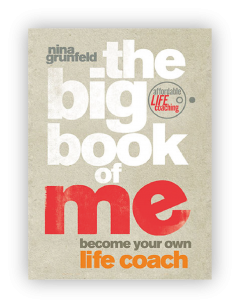
Enter Nina Grunfeld. This 51-year-old mother of four with a flair for ideas and masses of calm good sense (though she probably wouldn’t have been able to say that about herself until recently) has written The Big Book of Me, a guide to thinking more positively about yourself. Behind it lies a business idea that one day could be as much a part of life as book groups or slimming clubs.
“It came to me one day when I was looking at the McDonald’s sign,” she says. “I thought, that’s what I want: a presence on every street corner.” That presence would be the local branch of Life Clubs, the chain of self-help groups she started 18 months ago. Grunfeld envisages us all trotting along to a few life coaching sessions whenever we need to rethink our lives.
Life coaching is already a hit with those who can afford it. An executive-coaching session can cost £250 for just half an hour. The rich, including Madonna, Cherie Blair and Vanessa Feltz, seem to lap it up, and companies are increasingly offering this kind of session to staff. But, for most people, even ordinary one-to-one coaching at £60 an hour, is more than they can afford. Grunfeld has the solution: her group sessions cost only £15 each, because once a topic has been introduced the members are left to coach each other, albeit under expert guidance.
The interest certainly exists. Google “life coaching” and more than 18 million references pop up for courses, phone and internet coaching and books galore. The term was coined by a financial adviser from the US city of Colorado Springs, who found that his clients didn’t just want to be told what to do with their money, they wanted to make the best of every aspect of their lives – in short, “to realise their dreams”. To judge from the explosion of interest, it appears that his clients are far from unique.
Britain was slow to catch on to what sounded like a suspect American idea for making money by inflating already overblown egos. In the past five years, however, it has become a craze to equal sudoku. Dozens of colleges are training thousands of new coaches each year and it is impossible to know how many have tried its stimulating effects.
The appeal of life coaching is that it isn’t intimidating and you don’t have to feel like a screwball to need it. Its point is not to dwell on the past: the focus is on where you are now, where you want to be in the future and what’s stopping you getting there.
On the downside, life coaching can sound so waffly that it’s hard not to make Woody Allen-style jokes about being more loving towards yourself. And, with some courses churning out “trained” coaches after only two days, there have been tales of clients feeling cheated into paying for a few bland platitudes. Grunfeld, however, doesn’t think that means we should ignore its power to change lives.
“I know I can sound like a creep when I talk about it, so I try to avoid words such as ‘empowerment’ and ‘enlightenment’,” she says, conducting me upstairs from the child-filled basement to the paper-strewn drawing room of the Westminster house where she lives with her QC husband. “It’s hard to explain, but what life coaching can do is help you discover parts of yourself that you have forgotten. Sports people have coaches who say to them, ‘I know you can do it’, and it lifts their game.”
“Having a life coach is like having a personal fan club. It’s about unconditional love: the ideal relationship that you might have had with a parent, but maybe you didn’t. Life coaching is a way of learning about yourself, becoming more confident, understanding your motivation. I see people who have been life coached standing taller, looking me in the eye, coaching each other. One woman said her husband couldn’t believe how much happier she was.”
Grunfeld’s “don’t knock it until you’ve tried it” enthusiasm is enough to halt any knee-jerk scepticism. Indeed, the tendency to pour scorn on new ideas or resist the possibility that lives can be changed for the better may be exactly what holds people back. But, even if we would all benefit from having someone helping us work out what we want and how to get it, why pay a stranger? Wouldn’t it be simpler and cheaper to talk to a friend or relative?
“Not always”, says Grunfeld: “In the past, there was more support available, from the family or the Church, that doesn’t exist now.” Besides, as those who have been coached say, friends and relatives have their own agendas. They may not encourage those they like having nearby to move away, even if it is best for them, or help them become successful and then feel failures by comparison.
Grunfeld herself is a glowing example of what life coaching can do. A few years ago, she admits, she was Mrs Depressed-In-Suburbia. “Now I spring out of bed. I see life as an adventure.” Talking about her childhood, she sounds as if she might have been a prime case for more traditional shrinkage, but she is glad to have taken this practical approach.
“My problems were minor,” says Grunfeld, the child of two loving but critical refugees who divorced when she was young. Shuttling between her rich businessman father and her more cash-strapped mother, who felt an outsider in Britain, was tricky. “My father would say I never worked hard enough. My mother would say I was selfish because I wanted to help other people, rather than always help her.”
The tensions induced wild behaviour and led to her expulsion from St Paul’s Girls’ School in West London, which made her feel worthless. Then, when she was 20, her father took her to visit his family’s graves in Poland and announced that he was not her biological father.
“By then my real father was dead, so I couldn’t get to know him better,” she says, “but at least it explained the mystery of where my woolly hair came from.”
Although she has always wanted to help others, her early career involved graphic design and publishing. Her most notable success was Nanny Knows Best, the book and television series based on the wisdom of Nanny Smith, who had cared for her as a child. But, after her last baby was born seven years ago, Grunfeld decided to spend more time with the family and sent out a round-robin email announcing that she was going to be more professional about her hobby of advising people.
One respondent suggested that she look into the new field of life coaching, and she duly signed up for the first of many courses, which involved being coached herself. “I really enjoyed it,” she says. “It’s not like discussing whatever’s on my mind with my husband. Coaches are trained to ask questions such as ‘What is your goal?’ or ‘What will help remind you of that goal?’ It has helped me to come into my own, rather late in life. I used to want to disappear because of my vast amount of frizzy hair, now I like being the centre of attention.”
One of life coaching’s key elements is the balance chart, in the shape of a wheel with 10 spokes. Each spoke represents an aspect of life – money, family, career, fitness and health, and so on. The idea is to circle a number on each spoke to indicate how well that aspect of your life is going. Does Grunfeld now score a full set of 10s? “Not at all,” she says. “That’s not the point. Sometimes you are happiest scoring 10 for romance and very little on the others. It’s just a tool for noticing. I know I don’t spend enough time on social life, for example, but I’m doing something about that – having a party.”
Fortnightly coaching sessions still help her deal with worries and focus on what she is trying to achieve. They also make her more understanding when those she coaches are slow to achieve their goals. “Normally there is a reason for it,” she says.
Richard Porter, 33, was coached by her, and is amazed by the results. “I had been working all hours, doing my job and standing for Parliament, and my finances were in a mess,” he says. “I was so depressed that my GP put me on anti-depressants, but a friend told me about life coaching. Nina is very bright, with it and good with people, and I decided to look with her at one aspect of my life: my career. Now I’ve got a new job, more time and my finances are fine. Once you sort out one area, the rest seem to sort themselves out.
“One of the most useful exercises was to imagine meeting myself as I would like to be in 20 years. I had to envisage how I would like to look and what I would like to be doing, and then work out how to get there. There was no question of becoming too dependent on her: once I had achieved what I had set out to achieve, she suggested calling a halt. But I can always pop back. I now feel that most people who are depressed have just lost direction.”
Like many men, he is resistant to the idea of group life coaching. “I liked someone concentrating on me,” he says. So far it is mostly women who come to the group sessions held in several London locations, as well as in Salisbury and Ipswich, with more due to start in other parts of the country.
“Women are more comfortable talking about themselves,” says Grunfeld, who expects men will pile in when they realise that the groups are filled with go-ahead women, some of them eager to increase their score in the family and romance charts. “They aren’t like AA meetings. You don’t have to tell people everything about yourself.”
One divorced woman in her late 30s who took a Life Clubs course says she did so to broaden her social life, lose weight and keep positive. “Focusing on the week’s achievements boosted my confidence,” she says. “I was able to tell myself, ‘I did that, I did cope.’ At those moments when I couldn’t be bothered to go out, it gave me an extra incentive.” Another woman in her early 30s, who had just returned from working abroad, says: “In the past, things would just happen to me, but life coaching helped me to forward-plan, organise and prioritise. It’s easy to get stuck in a rut and criticise yourself.”
The feedback from these first groups is so encouraging that Grunfeld has written The Big Book of Me to spread the word still further. Her eventual aim is to see it introduced into schools. “It would have helped me so much when I was 16,” she says.
What is her own goal? To make money? “I’ve always been comfortably off so that doesn’t interest me. What I want is to create a product that grows, and to help other people.” And her New Year resolution? “To make sure I apply to myself the things I recommend to others.
HAPPY NEW YOU FOR 2008
To celebrate the publication of our 2008 journal, free with this month’s issue, Psychologies has teamed up with Life Clubs founder Nina Grunfeld to offer readers the chance to attend a Life Club session for half price during January.
The philosophy behind these weekly workshops is based on a similar principle to slimming clubs, ‘helping people to help people’. Every week, you set goals, note your achievements and enjoy ever-changing topics and discussions. By working with other ‘clubbers’, you will be inspired to make your already-good life better.
Psychologies Summer 2007
Tried and Tested: Life Coaching
Each month we investigate the best therapies on offer.
I guess it was a culmination of events that led to last year’s winter blues being worse than normal- a few of my close friends emigrated and I was living on my own for the very first time. I was also starting to question whether I was fulfilled at work and what I could do to make a difference, if at all. These uncertainties were becoming a constant source of anxiety and I worried that it was affecting my health.
The idea of therapy felt too extreme, but life coaching looked like it might be right for me, and I arranged a session with the founder of Life Clubs, Nina Grunfeld. I was apprehensive, but also curious – would I have to reveal lots of intimate details, would I have to lie on a couch, would she be able to provide me instant answers?
Luckily, there wasn’t a couch in sight, and it was very relaxed. We began by chatting about what I wanted to get out of coaching, how I felt about certain aspects of my social life and career and what made me happy. The discussion then moved on to my childhood – family holidays, special moments such as birthdays and time spent with friends. This was to try and work out what was important to me, what made me happy and more importantly what motivated me. She wrote down key words and, from that, we compiled a list of aspects of my life where I could make instant changes, with a particular focus on goal setting. Nina suggested that I set myself three different goals a week. This has been a real breakthrough, as it’s helped me realise that more structure and definition helps me identify what areas I need to address.
Nina explained that looking at my personality type might explain why I had been feeling so stuck. After our preliminary conversations, we concluded that I have a low boredom threshold and am constantly planning what to do next, even before I’ve finished with what I am doing at the time. This inevitably leads to disappointment – from work, relationships – even friends, as I am never happy just living in the moment. Understanding this has given me a new perspective on my particular issues, such as how my frustration with long term projects could be holding me back. It’s not something I can completely change, but I now recognise that I don’t need to make dramatic gestures in order to be fulfilled.
In an hour I learnt a huge amount from Nina, but the most important thing was the realisation that I wasn’t totally lost. Having someone show me processes and tools to question my decisions was vital, but it was even more reassuring to know that I could rely on myself for answers.
After my first session, I returned for a group workshop in which I learned more about my personality type. I’m going to carry on seeing Nina, as, although I have more clarity and direction, it’s helpful to carry on talking about some of the specific decisions I’d like to make. I hope these changes will bring me the happiness and fulfillment I’ve been looking for.
I'm Having A Life Slump! How Can I Become More Motivated?
You are not alone, especially at this time of year. So why not join a Life Club? The thinking behind these weekly workshops is ‘Helping people to help people’, as its members meet up to discuss their goals and achievements. There’s no pressure to attend every week, although most do once they realise the benefit of regular workshops.
Join The Club
Could a group of total strangers help solve all your problems? Ruth Hughes went to a life club and found she got by with a little help from her new friends
Every year, on 1 January, I make a batch of resolutions which last less than two weeks. At the beginning of 2007, the ‘new me’ pledged to exercise more, eat healthier food and stop procrastinating (I hardly ever open my mail, and have been known to stumble around in the dark for weeks before I get round to changing a light bulb). But I work such long hours as a freelance writer that I need to give up on these goals within a few days. Yes, I know – excuses, excuses…
I need someone to motivate me to stick to my plans, but can’t face the hefty fees that one-to-one coaching involves, so i’m going along to a Life Club, which costs just £15 for a 90 minute session. The idea is that a group of people meet to discuss their problems and possible solutions under the guidance of a life coach.
OK, so I don’t exactly relish the thought of discussing my new year’s resolutions with a bunch of strangers. But when I walk into the meeting hosted by Life Club founder Nina Grunfeld in the living room of her house in Westminster, central London, I’m relieved to see only about half a dozen people, pens and Life Club folders at the ready. My fellow clubbers include a translator, a secretary and a scientist. I’m intrigued to learn that a couple of them have been coming for almost two years.
The workshop covers a different topic each week, such as reducing stress and using a body language to help you get what you want. Today’s topic is creating success. People are encouraged to go every week to learn a range of skills which help them work towards any specific goals they may have and remain motivated.
This week, Nina instructs us to get into pairs and discuss what we’ve achieved in the past week. I stare blankly at my partner Debbie, 35, a social worker. She looks back at me, equally stumped. ‘Well, I tidied up my sock draw,’ I muse, but it’s not exactly a triumph. Thankfully, a woman called Sarah pipes up: ‘To be honest, I find it easier to remember the bad moments and all the thing’s I’ve done wrong rather than anything positive.’ I’ll second that.
‘Your achievement can be anything from completing a tax return to actually doing nothing at all,’ Nina tells us. ‘For those with busy lives, simply resting can be a triumph.’ Suddenly, climbing back into bed instead of going for that Sunday morning gym session seems quite positive.
This is Debbie’s third time at the Life Club. ‘I’d like to meet a bloke, so I hope coming here will give me the skills to achieve that,’ she says. That’s the genius of the idea – the format means it can be applied to any problem, from hating your job to struggling to get fit. For me, this weeks theme of creating success means getting myself more organised, while for someone else it may mean readying themselves for their dream job.
Nina hands out worksheets spanning the areas of our lives, such as careers and social life. We mark how happy we are with each. Both those areas score well for me, but things aren’t looking so good on the romance front. Here it is, in black and white – the long hours at work are damaging my love life. Perhaps I need to jot down another new year’s resolution.
Nina then encourages us to talk about our recent perceived failures, and challenges us to brainstorm with our partnerabout how that ‘failure’ could be seen as a success. Suddenly, my failed attempts to clean the house and sort out my filing (I lazed on the sofa and watched telly instead) became much-needed relaxation time after a hectic week. Chatting to Debbie helps me realise how I’m often too hard on myself and that what I often see as negatives are actually pretty positive.
‘Visualise the person you want to become,’ says Nina. Hmm, forget shoulder-padded power vixen – I want more me-time. It then strikes me that one thing I’ve neglected because of working long hours is my diet. I live on ready meals, so I visualise scoffing platters of healthy salads and smiling, having left the office on time for once. It seems like a positive, achievable image.
Nina explains: ‘The idea is that you’re discovering yourself – who you are and what you want, so you leave feeling good about yourself with the tools to move forward.’
There’s nothing I like more than a good old whinge with a girlfriend over a glass of wine, so did the Life CLub put an end to all that? Well, I certainly walked out feeling super-positive and motivated by my new way of looking at life. I’m focused about what I want to achieve and how I want my life to be – and i think that in itself will help me achieve it.
Join The Club And Change Your Life
Self- help groups started by life coach Nina Grunfeld are springing up throughout the UK. Sally Williams checks out this new trend – and is impressed.
“Ready? Right, OK, let’s begin. Anything really nice happened to you today?” Silence. “OK, I admit, this can be really difficult. We’re so used to thinking, ‘Oh nothing good happened to me today’, but there is always something nice.” Silence. “Hang on a minute, the sun is shining and that is nice because this morning it was raining! Fantastic!” It is 6.30pm on a Monday in summer. We are in central London, near Parliament Square, and the speaker is a middle-aged woman named Nina Grunfeld, who is “releasing the full life potential” in a group of eight people around a table. To them she is important. She is crucial. She is changing lives. “I went swimming,” volunteers a man with glasses. “Great! Thank you!” beams Nina.
And now, everyone wants to join in. Everyone wants to tell Nina that one thing that made them happy today. Brian filled out his tax form. Sandra read the newspaper. Caroline was offered a promotion. “Although I’m not sure I want to take it.” But anyway, “that’s great news!” says Nina, “Fantastic!”
This opening drill, as any “clubber” will tell you, is from Life Clubs, a chain of self-help groups, which meet once a week, for 90 minutes, around the country. Launched in 2003 by Nina Grunfeld, a 53-year-old-mother of four, Life CLubs provide “a lovely place to go and think about yourself”. It’s not, she stresses, therapy. This missus the point. The point is not to go backwards, but forwards. The point is “personal development” not “personal recovery”. “When you need to lose weight, you go to WeightWatches; when you feel like having an injection of energy, you come to Life Clubs.”
Life coaching is already a big hit with the rich. Madonna, Gwyneth Paltrow and Hillary Clinton are among those who have lapped it up. Companies, too, are increasingly offering sessions to staff. But it is expensive. An executive session can cost anything up to £300 an hour. Even ordinary one-to-one coaching, at £60 an hour, is more than many can afford. Grunfeld feels she has the solution: her group sessions cost only £15. Once a topic has been introduced the members are left to coach each other, albeit under expert guidance.
The term life coaching was coined by Thomas Leonard, a financial adviser from California, in the early Eighties; he had found that his clients wanted broader guidance as well as financial advice. Britain was slow to catch on, but now “personal development” is a new craze. The ranks of advisers, therapists and gurus who claim they can turn your stressed existence around are swelling fast. The Somerset-based Life Coaching Institute saw student numbers treble to 2,000, in 2006, while the UK College of Life Coaching predict numbers will double again by the end of 2007.
But Nina is keen to distance Life Clubs from this bandwagon. “Like counselling, life coaching will go in and out of fashion; I see Life Clubs as something that will always be there when you need a shot in the arm.” The appeal, she says, is that it isn’t intimidating, and you don’t have to feel crazy to need it. Neither does it build up an expensive reliance, as with traditional therapy – you can drop in, as you like. “It’s for people who haven’t particularly got anything wrong with their lives, but every so often we all need a bit of support.” This applies particularly at times of change, for example during a divorce or at retirement. She adds: “Someone said, Life Clubs are like stepping into a warm bubble bath. People feel invigorated afterwards. They come out almost skipping.”
The most important thing people learn from Nina is positive thinking. In person she is straightforward and direct, tall and powerful-looking, but the key to her success is an enthusiasm that borders on religious zeal. Phrases fall from her lips like “maybe is not the right word – you will do that” and “be conscious of your successes” and “what are you waiting for?”
Life Clubs and their spin-off guide, The Big Book of Me – together with her gung-ho, can-do positivity – are aimed at creating the life you want. “I am an eternal optimist,” she admits. But then, it’s an emotional strategy that has served Nina well.
Brought up in London, her parents, both refugees, divorced when she was six. Thereafter, she shuttled between her rich, businessman father and her mother, a former photographer. Tensions induced rebellious behaviour and she was expelled from scholl at 17. A further shock came at 20 when her father announced that he was not her biological father. “My real father had died by then,” she says, “but at least is explained the mystery of where my woolly hair came from.”
Her early career was in graphic design and writing books. She is perhaps best known for Nanny Knows Best, the book and television series based on the wisdom of Nanny Smith, who had looked after her as a child. The turning point, however, was the surprise arrival of the fourth child, when she was 44.
She decided to spend more time with her family, and be more professional about her hobby of advising people. “I’ve always liked helping my friends discover what the passions in their lives really were and helping them get into the careers they could shine in.” She trained as a life coach, and thoroughly enjoyed it.
“I love seeing people change, that is very exciting, but I think what I’m really enjoying is building up my business.” She writes all the material, designs the graphics, and drives marketing. With her Life Clubs – 20 of them from Edinburgh to Tunbridge Wells – she has finally found her métier. “I have come into my own rather late in life,” she says. “I used to want to disappear because of my vast frizzy hair, now I like being the centre of attention.”
Rian Roberts, 68, is a cheering example of what Life Clubs can do. A former divisional MD of a research company specialising in marketing and advertising, Brian retired at 63. At first he was euphoric. He had devoted his life to his career, and providing for his family. By the time he retired, he was divorced with two grown-up children, and was looking forward to freedom and spending time with his new partner.
Four years later he was feeling lost and unhappy. “I was wondering what it was all about really. I had no particular financial worries, and a roof over my head, but something in you calls to create this hive of activity so that you are stressed every second of the day.”
Brian decided to go along to a Life Club meeting. “It was just very useful. It covered things like relationships, change, and how it happens. It produced insights into what was important for me to do at that time – and all for 15 quid a week.” He likes the practical approach. A key element is a wheel-shaped chart with 10 spokes, each representing an aspect of life – money, family, career, fitness, health, and so on, The idea is to circle a number on each spoke to indicate how well that aspect of your life is going. “It gives you a structure for how to think about your life,” explains Brian, “And if you’re not happy with it, you change it.”
After a few meetings, it emerged that one of Brian’s main obstacles to happiness was his home, which he neglected since moving out to live with his partner. He threw away whole chunks of his past: the boxes full of bank statements, the stereo speakers that no longer worked, the first computer he’d bought. He felt cleansed; had been forced to confront what he’d outgrown. He had taken stock and could now move on.
Frances Howard, 68, local historian, was also amazed by the effect of her visits to a Life Club. Among the many attractions she lists: a chance to hear how others sort out their problems (Frances lives alone, works from home, and is widowed) and a welcoming atmosphere; she particularly enjoyed the support of younger people in the group. She said: “It’s not always easy to understand where young people are coming from; sometimes I found I was being a bit reactionary. It’s good to find out what pressures are on them.”
The enthusiasm for Life Clubs is pretty clear. The only problem, it would seem, is finding the time to go. “It almost feels like a guilty pleasure to give oneself an hour or so, and sit somewhere nice and be treated reasonably,” says Jennifer Dodds, 56, a market researcher. She has three demanding daughters in their early twenties,a mother-in-law with Alzheimer’s, and a mother “with bits falling off her.” Women of her age, she points out, “can feel squeezed on all sides”. As a result, when she surfaces from an evening of “positive affirmation” at her local Life Club, she comes out glowing. That’s how good it is.
Back in Nina’s workshop, Big Ben is sounding eight o’clock. “So, tell me what you’ve learnt that you can take out into the world,” Nina asks the group.
They take it in turns to speak. Caroline is not going to be so hard on herself. Sandra is going to take up horse riding. Brian is going to book that trip to Thailand and Colin, a balding thirtysometing who works in HR, when asked to picture what he used to be like, exclaims, “I am a punk rocker! Yes. A punk rocker. And I need to remember that!”
Life Coaching
Nina Grunfeld set up Life Clubs in the belief that the technique is ‘wonderfully exciting and empowering and really helps you move forward in your life – but until now has been very expensive’. Her solution is group coaching.
Make A Decision The Light-Bulb Way
1. Write down one decision you have to make this week.
2. Imagine you are already the successful person you want to be. Really imagine being that person, that successful you.
3. Now make the above decision as that person.
This Is The Week To...
Monday 25 June:
Need a new kind of self-help?
Life Clubs, which are designed to identify your strengths, take the movement to a new level and are popping up everywhere.
Under The Thumb?
Has your missus got you right where she wants you? Tick the boxes and find out
FRIENDS AND FAMILY
a) You haven’t been on holiday without her in the last two years
b) You lost a friendship because she hated your mate
c) You’ve moved house to be closer to her mother
d) You go out with her idiot brother to get in with her parents
e) You know the names of all three of your future children
So her family is a nightmare – but family isn’t the best place to start your disagreements. “Do a tit-for-tat – let her gossip on the phone once in a while and she’ll put up with your odd drunken evening out,” says Nina Grunfeld, founder of Life Clubs.
DOMESTIC BLISS
a) If you leave the house in the morning without making the bed you feel guilty all day
b) She has bought you more than three of these items: a) socks b) toothbrush c) underwear d) haemorrhoid cream e) an OC DVD box-set
c) She has thrown away your stuff without asking/telling you
d) You do her DIY to avoid a two-day guilt trip, rather than out of a manly instinct to saw things up
e) You always drive. Always
Why not try switching the radio from XFM to a bit of organ music – research at Adelaide University found that ‘Air’ from Handel’s ‘Water Music’ significantly reduced feelings of domestic stress. “There’s no way she’s going to stop you leaving the lid off the toothpaste tube no matter how much she nags you and the sooner she realises it the better for both of you,” says Grunfeld.
TIME OFF
a) You’ve watches two or more of these films: Dirty Dancing; Bridget Jones’ Diary; Sleepless in Seattle; Failure to Launch
b) You’ve rearranged a work appointment to take time off when she has a cold
c) She no longer even makes the pretence of reaching for her credit card at the end of a meal
d) You clear your phone memory of photos of nights out even though you’ve nothing to hide
e) You’ve been to a James Blunt concert and not walked out in a blind rage
Don’t let all of her interests become yours. “Swap films – ‘Sleepless in Seattle’ for ‘Terminator’ and concerts – James Blunt for Plan B, or buy her two tickets so she can go with a friend,” says Grunfeld.
MANNERS
a) You make liberal use of your internet search engine’s “delete history” facility
b) You wait till she’s asleep before picking your nose/farting/going for a sly wank
c) You pay for her to have her hair done. How did that happen?
d) You speak in a ridiculous baby language which if your mates ever overheard, you’d die
e) You know the difference between a French and American manicure
There’s a reason she liked you in the first place – and it’s not that you acted like her poodle and did whatever she said. “It’s great to be interested in the things she likes but it’ll feel much better when she talks in your language too,” says Grunfeld. “Give yourself a daily quote of at least five sentences beginning with “I”. That’s ‘I’d like…’ rather than ‘I’ll do’”.
SEX LIFE
a) You know what brand of tampons she uses
b) You’ve considered a vasectomy because the pill makes her grouchy
c) Porn has disappeared from its hiding place, and you can’t complain without admitting you had it in the first place
d) You tut at pictures of Paris Hilton and pronounce her “too thin” for your tastes
e) You deliberately bury your instinctive feelings of terror and revulsion when holding babies
“Maybe she’s uptight because you’re not turning each other on,” suggests Grunfeld. “Ask what she likes or experiment until you get there.” Finding a sexual balance is a key part of a successful relationship.
HOW DID YOU DO?
Less than 5 ticks:
THE THUMB SUCKS
The playstation is on, and the pizza boxes are piling up. But beware. If it’s all take, take, take on your side, then she’ll be take, take, taking the first opportunity to jump ship.
6-10:
THUMBS UP
Your mates might scoff when you duck out of the odd footie match to have dinner with your lady’s folks. Let them scoff. You’ve got things under control. Maybe she’s worth cherishing – so long as she does the same to you.
11-20:
THUMB WARS
You fought the thumb, and the thumb won. Make a list of things you are unwilling to give in on. Unleash your inner Rab C Nesbitt once in a while.
21-25:
RULE OF THUMB
You’re so under the thumb, you’re going to be there until you fossilise. Say; “I know you’ve been busy, but I want to know our relationship is important to you. I want you to make time for me and for us.”
What Are Life Clubs?
Life coach Nina Grunfeld realised not everyone could afford one-to-one sessions. So she set up Life Clubs (lifeclubs.co.uk) to help people get more out of life.
A growing number of groups meet across the UK each week for 90-minute structured workshops, which are supervised and run on the principle that it’s easier to open up to a stranger. It’s up to a stranger. It’s up to you how often you go and a different topic is discussed each time.
Graham Croney of Woodbridge, Surrey, says: “Being at Life Clubs helped motivate me to start a long-term goal, which was to write a play – this gave me an enormous amount of satisfaction.”
When It's Time To Put Yourself First
You gave your twenties to your career and your thirties to your family. Now it’s your turn. Life coach, and founder of Life Clubs, Nina Grunfeld explains how giving back can start with you
The other week, I was holding a workshop. It was a really long, gruelling day and by the end I was exhausted. As the participants got ready to leave, I noticed it had started raining heavily. My immediate reaction was, “I must give them all a lift to the train station,” even though it was miles away and I’d have had to make more than one trip. Then I gave myself a lecture: “Actually, Nina, you’re very tired and in a little while you need to go home and give some attention to your family. Just take a rest.”
The solution was simple – they took a taxi, I didn’t drive to the station and I admit that I’m glad I didn’t. I got a necessary break and my kids got a mother with a bit of energy left for them.
It may come as a shock but selfishness is NOT a dirty word. In fact, it’s essential. So many of us are brought up to think that putting ourselves first is wrong. Becoming parents just reinforces the notion that everyone else’s needs are more important than your own. But what happens to a plant if you don’t look after it? It dies. The same thing happens to you if you don’t nurture yourself – sooner or later you’ll lose sight of your sense of identity, which is disastrous for you and the people you love.
Somewhere we’ve adopted the idea that we all have a finite amount of energy and love and if we use it up on ourselves, we’ll have none left for anyone else. It’s actually the opposite – the more attention you give yourself, the better equipped you’ll be to give attention to other people – and the more you’ll feel like it.
It’s great to retrain our mindsets into more of a “me mentality”, but breaking the habits of a lifetime can be harder than you think. Here’s how to finally start looking after number one after all those years of looking after numbers two, three, four etc…
1. Spend an hour a day doing what you want
Sounds easy doesn’t it? But sometimes even just recognising what you want can involve a degree of reconditioning. It might be staying in bed an extra hour, eating popcorn instead of lunch or going to a sauna just because you feel like it. As a rule, if you can hear your mother’s voice in your ear saying, “Surely you don’t intend to do X at this time of day?” it’s probably something you really want to do. But if that degree of selfishness takes too big a leap of faith, work up to it by listing three things you want to achieve every day – two of which could be worthy (like doing the supermarket shop, filling in your tax return) and the third entirely, deliciously self-centered. That way you can slot the selfish thing into your normal duties so that you make time for it, instead of feeling guilty that you probably should be doing something else.
2. Rewrite you “self CV”
Write a list of achievements. These could either be things you’ve accomplished up until now or in the last week or even things you achieve from this point on. It doesn’t matter how major they are – it could be finishing a book or playing a game of tennis – just as long as they’re things you’ve done purely for yourself. So, sending a son off to university wouldn’t count, but throwing a great party would. It takes confidence to be selfish and put your needs first – and writing a self CV is a great way of building up that self-assurance.
3. Release your inner child
Find photos of yourself as a child and put them up somewhere obvious. Not only will that remind you of all the aspirations you had when you were younger, it will also urge you to be kinder to yourself. If you start treating your adult self as well as you’d rear that child, you’ll be on the way to achieving healthy selfishness.
4. Set your goals
If you achieve what you want, you’re going to be a much more fulfilled person and more rewarding to be around. Make sense, doesn’t it? Sure, sometimes dreams are unattainable (marrying Danial Craig, ending world poverty and so on), but if you work out what was important about that particular desire, you might be able to get the same satisfaction from a different, more achievable goal. So, for example, I always wanted to build my own house. Why? Because the idea of creating something from nothing and being in sole charge seemed like absolute bliss. Well, I never built a house, but what I did do was start up my own business. I’ve replaced one vision with another and it’s giving me what I craved. Think about your wildest, most ambitious dream, then ask yourself what it is about that fantasy that appeals to you. Now try to work out a realistic way of getting it in your life.
5. Sack the friends who bring you down
Ouch, that sounds harsh. After all, aren’t we always taught to stick by our friends no matter what, through thick and thin and all that? Well, the truth is that some friends are natural born takers – they take your time, your energy and, worst of all, your dreams. So many people come to me who have had their ambitions shot down by their so-called friends. You don’t need influences like that in your life. Being selfish is about surrounding yourself with those who are on your side – and getting shot of any who aren’t.
6. Spell out what you really want
Many of us are too scared to say what it is we want in case it makes us look arrogant or greedy. But if you don’t say what you want, how on earth are you going to get it? That’s where a whole load of problems can start. You’re husband isn’t cooking dinner three times a week, which would free you up for that pilates class you really want to join. Therefore he isn’t supportive to your needs, right? Wrong. He might be completely willing to support you, if you told him what your needs were. Healthy selfishness is about communicating your wants and giving the people who care about you the chance to fulfil them, which in turn makes them feel good. It’s a win-win situation!
7. Stop the self put-downs
“I’m too fat to wear one of those,” or “No way could I ever have the confidence to do that”. It’s so easy to fall into the self-deprecation habit and it’s so destructive. How can you give yourself permission to be selfish if you’re telling yourself you’re unworthy? And that’s precisely why you do it. Every time you put yourself off having to think about what you want and how to get it.
Next time you say something negative about yourself, stop and think why. If you say, “I’m not confident,” what is that statement stopping you from doing? Having wild sex? Putting up flatpack furniture? Joining a running club? Once you stop the self put-downs, you’ll start realising you are good enough to get what you want – and that’s when you can start making your dreams come true.
Life Clubs: Contact us on +44 (0) 207 22 22 199 or nina@lifeclubs.co.uk, Smith Square, London SW1P 3HS, England
About Us | Blog | Books | Bulletin | Clubs | Contact Us | Corporate | Press| Run a Club | Success Stories